Programmable hardware for AI agents

Give your agent its own workbench.

Legible Space is a hosted workbench where your agent can wire circuits, run firmware and take measurements on real components.

Choose parts from the library. We install them on a programmable breadboard and give you remote access within 15 minutes of your request. Test the circuit and its firmware before ordering a PCB.

Join the waitlistSee how it works

[ Demo video placeholder ]

A legible space is a physical environment that can be measured and manipulated with precision.

How it works

1 · Choose the components

Select the MCU, peripherals and supporting parts you need from the library.

2 · We prepare the bench

Our team installs your selected components. Our setup SLA is 15 minutes from component request to bench access.

3 · Connect remotely

Your agent specifies which pins should connect. The switch matrix makes the connections and routes power and measurement inputs.

4 · Run, measure, revise

Flash firmware and measure the circuit as it runs. Change the wiring or code, then repeat the test.

Once the bench is ready, your agent can change connections between the installed parts through software. Adding or replacing a physical component requires our team to update the bench.

For a sensor board, a test might check whether a device responds at its I²C address, whether its driver returns valid readings, or how much current the circuit draws in each operating mode.

Control the bench from code

The planned interfaces are a CLI, an API and an MCP server. They give your scripts and agents remote access to the bench's connections and instruments.

CLI

Set up a circuit and run a test from your terminal.

API

Control connections and read measurements from your own test scripts.

MCP

Let an agent call bench operations as tools through the Model Context Protocol.

Testing environment

A breadboard with software-controlled connections, programmable power supplies and built-in measurement inputs.

The five holes in each breadboard row are electrically connected. An analog switch matrix connects those rows to other rows, power rails and instruments. Software changes the switch settings to rewire the circuit; the components stay in place.

Reference hardware: Jumperless V5. The specifications below describe that board.
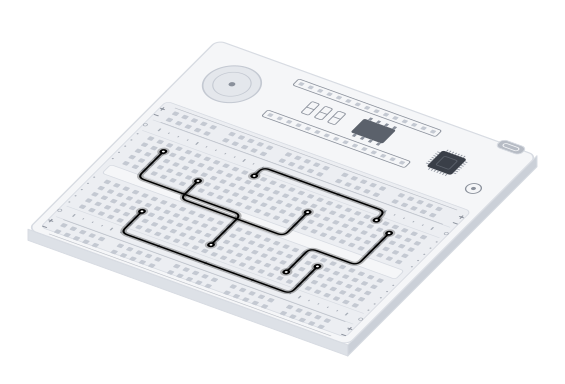
Illustration of a programmable breadboard with connections highlighted in blue

Connections

60 breadboard rows, with five holes per row. Twelve CH446QAn 8×16 analog crosspoint switch. Multiple switches can form a path between two nodes. chips route connections. A Raspberry Pi RP2350BThe board's controller. It runs the routing firmware, USB interface and onboard MicroPython interpreter. controls the board.

Power and measurements

Four programmable outputs, adjustable from −8 V to +8 V, and five voltage measurement inputs. An INA219Measures current through a shunt resistor, along with bus voltage and power. One monitor is routable; a second serves an internal measurement circuit. monitor measures current. GPIO and UART signals can also be routed to the circuit.

What a breadboard test can tell you

You can exercise firmware against physical devices and check the circuit's behavior. The switch matrix adds resistance and capacitance, which affect measurements and limit the signals it can carry. RF and high-current paths need a different setup. PCB layout, thermal behavior and EMC still need validation on the finished board.

Jumperless V5 hardware specifications

Legible components

Choose the MCU and peripherals your firmware targets, along with pull-up resistors, decoupling capacitors and other supporting parts.

Planned library categories. Specific parts and availability are still to be confirmed.

MCUs

Run the firmware under test.

Sensors

Check initialization and register reads.

Power

Check supply control and sequencing.

Passives and discrete parts

Resistors, capacitors, diodes and transistors.

Pricing

Proposed plans. Prices and included bench time are still to be confirmed.

Community

Team

Dedicated bench

Join the waitlist

What would you like us to put on your bench? Tell us which MCU and peripherals you want to use, and what you need to test.

Wireframe only. This form does not submit.